Editorial
Preface 2023
Preface – magazine 2023 A contemporary magazine feeds upon dynamism and vigour. It instantly perceives the inputs deriving from the readers and evolves, offering its best at...
Filter by Category
Preface – magazine 2023 A contemporary magazine feeds upon dynamism and vigour. It instantly perceives the inputs deriving from the readers and evolves, offering its best at...
What does a dish with a Ligurian name have in common with Arab and Asian roots and a genuine Neapolitan culinary tradition? Genoese Tria is not a simple dish: it’s an aggregate of...
Food, charity, and community in the Middle Ages and the Renaissance Florence, between the thirteenth and sixteenth centuries, was not only the city of merchants, bankers, and...
One does not live by bread alone, it is true; one also needs the side dish, and the art of making it cheaper, tastier, and healthier, I say and maintain, is true art. Let us...
A man who has not been in Italy is always conscious of an inferiority, from his not having seen what it is expected a man should see. (Samuel Johnson). The journey to Italy was a...
Il pellegrinaggio a Roma, noto come Giubileo, ha rappresentato per secoli un momento di profonda spiritualità e devozione. Nel Medioevo erano chiamate vie romee le strade che i...
In the first century of the Common Era, the Roman Emperor Claudius, who ruled from 41 to 54 AD, was a passionate scholar of the Etruscans. He published, in the Greek language, a...
What would we need one day if everything goes awry? Gold, oil, diamonds? The answer could be different and, in a certain way, unexpected: seeds. Small but essential, vital for us....
Around the mid-fifth century BC, the famous Greek historian Herodotus of Halicarnassus visited Egypt. Later, when he wrote the celebrated Histories, he dedicated the entire second...
For comedy writer and director Eduardo de Filippo, one of the geniuses of Italian and Neapolitan theatres of the 20th century, food always had great value. For him and every...
by Ilaria Persello According to an estimate from Coldiretti, the federation of Italian farmers, reported some time ago inside Il Sole24Ore, 60% of pet owners spend between 30 and...


What does a dish with a Ligurian name have in common with Arab and Asian roots and a genuine Neapolitan culinary tradition? Genoese Tria is not a simple dish: it’s an aggregate of curiosity, linguistic enigmas, and a living testament of how food travels, evolves, and varies through centuries.
The enigma of the name: among Syria, Greece, and Genoa.
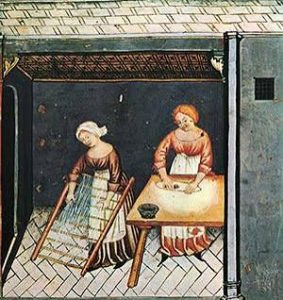
The word “tria” has its roots in ancient times: it is cited as itrija or itriya in Syrian texts of the XI century, or it derives from the Greek itria, indicating the result of a bran base thinly rolled out and then cut into stripes. In the Middle Ages, this term indicated several types of pasta.
Why then call it Genoese if its historical roots plunge into the southern Mediterranean Sea? The answer lies in a game of historical hypotheses: the port of Naples was, in past centuries, a fundamental crossroads for people and trade. They suppose that a prolonged presence of Genoese mariners, who usually frequented the city for commercial exchanges, introduced the use of seasoned foods with this peculiar sauce made from braised onion, inextricably tying the name to this technique.
The technique: not just simple boiling.
Something often misunderstood by literal translators of Medieval manuscripts is the following passage: suffrige cipolas cum oleo et mite in aqua bullienti. If we read it with approximation, it seems an absurd boiling of onions after frying them. In reality, experts in culinary art interpret this act as the technique of brazing (or tombeau): the onion is sautéed in oil and then finished cooking in water. This way, the onion becomes soft and quite melty. It is the same principle that, centuries later, has made modern onion soup famous.
The evolution: from Medieval simplicity to the modern rites
In the Middle Ages, pasta was not the solitary protagonist of the plate; it was a precious accompaniment. The present version of Genoese Tria in Campania has evolved over time, transforming an archaic heritage into a pillar of its regional cuisine, preserving three key elements: onions, pasta, and, in its richer variants, stewed meat.
If the oldest version, as described in some documents (among which a recipe book of Emperor Frederick II and his ‘tria ianuensis’), is an homage to simplicity and the use of few essential ingredients, the modern Genovese we know today represents a real monument to patience. Characterised by a long, slow cooking process of steamed meat and sautéed celery, carrots, and onions, it represents the perfect synthesis between the story of past centuries and contemporary delicacy, where the sauce becomes the undisputed protagonist, enhancing the taste of pasta.
Whether it is the ancient Medieval tria or the sumptuous modern-day Genovese, we are dealing with a story of migration, maritime encounters, and the masterful handling of cooking times—a process capable of transforming humble ingredients into gastronomy icons.