Editorial
Preface 2023
Preface – magazine 2023 A contemporary magazine feeds upon dynamism and vigour. It instantly perceives the inputs deriving from the readers and evolves, offering its best at...

Filter by Category
Preface – magazine 2023 A contemporary magazine feeds upon dynamism and vigour. It instantly perceives the inputs deriving from the readers and evolves, offering its best at...
The magic of a place between history and the present day By Nicoletta Arbusti On the sixth floor of the historic The Excelsior, a Luxury Collection Hotel – Marriott in...
What does a dish with a Ligurian name have in common with Arab and Asian roots and a genuine Neapolitan culinary tradition? Genoese Tria is not a simple dish: it’s an aggregate of...
Food, charity, and community in the Middle Ages and the Renaissance Florence, between the thirteenth and sixteenth centuries, was not only the city of merchants, bankers, and...
One does not live by bread alone, it is true; one also needs the side dish, and the art of making it cheaper, tastier, and healthier, I say and maintain, is true art. Let us...
A man who has not been in Italy is always conscious of an inferiority, from his not having seen what it is expected a man should see. (Samuel Johnson). The journey to Italy was a...
Il pellegrinaggio a Roma, noto come Giubileo, ha rappresentato per secoli un momento di profonda spiritualità e devozione. Nel Medioevo erano chiamate vie romee le strade che i...
In the first century of the Common Era, the Roman Emperor Claudius, who ruled from 41 to 54 AD, was a passionate scholar of the Etruscans. He published, in the Greek language, a...
What would we need one day if everything goes awry? Gold, oil, diamonds? The answer could be different and, in a certain way, unexpected: seeds. Small but essential, vital for us....
Around the mid-fifth century BC, the famous Greek historian Herodotus of Halicarnassus visited Egypt. Later, when he wrote the celebrated Histories, he dedicated the entire second...
For comedy writer and director Eduardo de Filippo, one of the geniuses of Italian and Neapolitan theatres of the 20th century, food always had great value. For him and every...


The magic of a place between history and the present day
By Nicoletta Arbusti
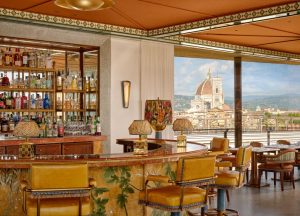
On the sixth floor of the historic The Excelsior, a Luxury Collection Hotel – Marriott in Firenze, you will surely find the most beautiful 360° panoramic view of the entire city.At the Cosimo Rooftop Bar and Restaurant, Florence appears like a wonderful postcard, where you recognize all of its historical monuments, and the feeling is one of an otherworldly and ancient peace, an oasis far away from the noise of the city centre’s streets and the crowds of tourists.
The Excelsior Hotel overlooks Piazza Ognissanti and the Arno River, and is known as Palazzo Bonaparte because a section of the building belonged to Carolina Bonaparte, Napoleon’s sister, where she spent her final days. However, the story of this property dates back even further in time.
After 1839, the building was used as a hotel, and in 1871 it took the name of Hotel Excelsior d’Italie.
The entrance to the hotel faces Piazza d’Ognissanti, which has an ancient history going back to 1200, involving the church and the industrious Ognissanti Convent founded around that time by the Humiliati monks. The order is now extinct, but for over three centuries it strongly marked the area with its involvement in the manufacturing, colouring, and drying of wool.
That district was on low ground compared to the level of the River Arno, cut through by canals along which worked the caligai, leather tanners.
The reclamation of that land was fulfilled by the Humiliati and their vast convent, which looked like an industrial island surrounded by artisans’ houses and tiratoi, tenter houses where wool carders operated, working, colouring, and drying the wool.
They walled the Ponte alla Carraia, the second Florentine bridge built in those years, and also constructed along the river the “Pescaia (weir) of Santa Rosa”, which we still see today to maintain the water at a certain level, also in dry periods. They also regulated the flux of the canals where water flowed, putting mills and fulling mills in motion, or to empty the tanning and dye-works’ waste.
Many mills that operated in this area over the centuries have now disappeared. On the corner of Lungarno Vespucci, on Via Curtatone, close to the American General Consulate and the Excelsior Hotel, a plaque celebrates the composer Giovan Battista Lulli. He was born here in 1632, in the home belonging to his father, which included a mill that once belonged to his father-in-law, a miller.
The very same Humiliati named the new neighbourhood, namely a road outside the old city walls, with the church dedicated to Saint Salvatore and the Queen of all saints, from which derives the short name of Ognissanti (all Saints).
By the end of 1200, the Humiliati, for their prestige, were asked to hold significant public offices, while the Church of Ognissanti was filled with prestigious works of art of extraordinary quality—gifts from local families who had achieved a solid economic and social standing—and became a vibrant centre of the city’s republican political activity.
Sandro Boccicelli worked there in 1440 – buried in the church next to his muse, Simonetta Vespucci – and Ghirlandaio too, hired by the Vespucci family, which included the navigator Amerigo, who gave his name to America and lived nearby in the palazzo bearing the same name.
Amerigo Vespucci and Carolina Bonaparte are also buried in the church.
Moving forward in time, in 1871, the Excelsior became the Hotel d’Italie, incorporating Palazzo Bonaparte into the building on Piazza Ognissanti.
In 1927, both structures were acquired by the Swiss hotelier Gérard Kraft, and the name was officially changed to Hotel Excelsior.
In 1951, the architects Nello Baroni and Pietro Porcinai realized the Roof Garden, with the help of the designer Maurizio Tempestini.
In 1958, the CIGA, owned by the Aga Khan Karim IV, bought the entire structure, which would become his point of reference for his travels to Florence.
Among the most illustrious guests of the hotel in the twentieth century are Arthur Rubinstein, Charlie Chaplin, Orson Wells, Henry Ford, Maria Callas, Arturo Toscanini, some presidents of the USA, and thus it became one of the best addresses of the international jet set.
Today, the Cosimo Rooftop Bar and Restaurant, with its marvellous terraces and breath-taking views, suspended between the sky and the earth, has become an exclusive and refined location in Florence. A place that carries the tradition of an international spirit, and where one can enjoy a reinterpretation of Tuscan tradition with a contemporary touch, enhanced by drinks dedicated to the women of the Medici family.
Seasonal ingredients and artisanal techniques honour Tuscan cuisine through a contemporary lens, keeping pace with innovation.