Food and History
THE CUP OF NESTOR
The wine in a Greek inscription from the 8th century B.C. Since ancient times, oil and wine have been very important elements in the diet of the Greek and Italian populations. It...

Filter by Category


Since ancient times, oil and wine have been very important elements in the diet of the Greek and Italian populations. It is, therefore, no coincidence that one of the two most ancient testimonies of the use of the archaic Greek alphabet, namely a phonetic writing system, concerns the consumption of wine at banquets. We allude to the inscription traced on a vase known as “the Cup of Nestor”, coming from the necropolis of Lacco Ameno d’Ischia (the ancient Euboean colony of “Pithekussa”). The absolute exceptionality of the artefact not only is underlined by numerous scientific studies, but also by its presence inside international and national exhibitions.
From November 2019 until March 2020, the British Museum in London will house a fabulous “Troy” exhibition, dedicated to archaeological and literary evidence related to the ancient city of Troy.
Thanks to the Iliad and the Odyssey, this city was renowned since ancient time and became an archaeological reality after Schliemann’s nineteenth-century excavations that brought to light its remains and proved its historical evidence.
The exhibition will also display a famous Greek artefact, the wine cup from Pithekussa we have mentioned earlier. The cup was found in 1955 in the cremation tomb of a young man, and dated to the second half of the 8th century B.C.
It is a poterion, a wine cup (about 10.3 cm high and 15.1 cm wide), made with geometric motifs and bearing an inscription, on three lines just above the base of the vase, written from right to left, a characteristic of the archaic Greek alphabet.
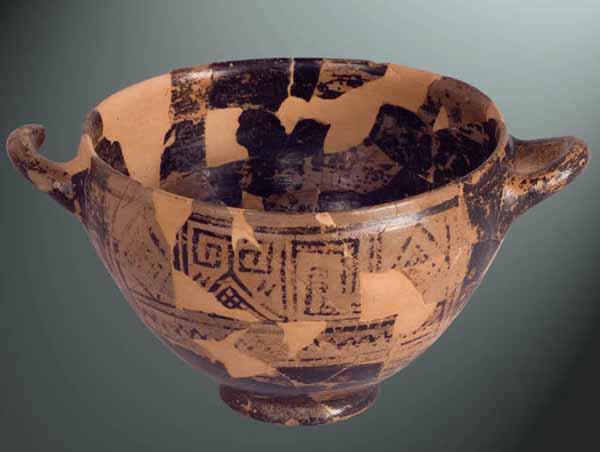
In this case, the characters belong to the “western”, “red” Greek alphabet, which will represent the model for the Etruscan and Roman alphabets.
The text is composed of three verses; the first is perhaps an iambic meter, the others are dactylic hexameters, namely the verses of the Homeric epic, already well known at that time, not only in its country of origin but also in the colonies.
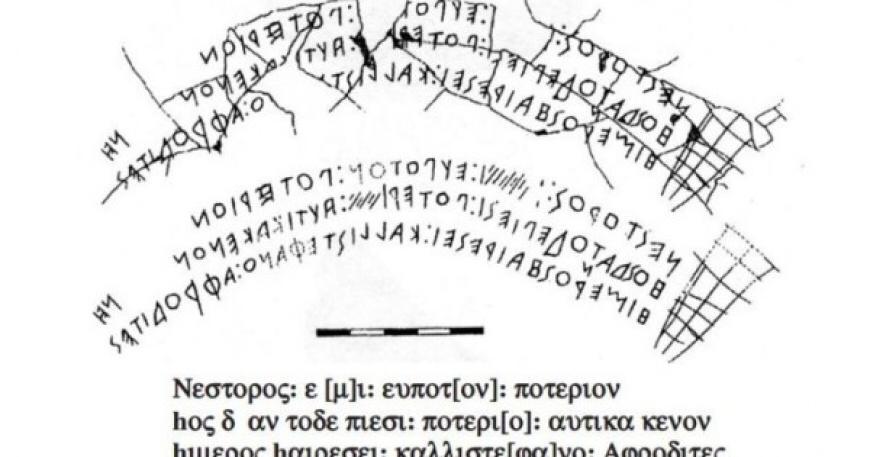
Scholars debate on the text and the translation of the first verse; personally, following the interpretation of the famous Florentine epigraphist Margherita Guarducci, I propose: “The cup of Nestor (was) so pleasant to drink”, “but whoever drinks from this cup will immediately seize the desire of the beautifully-crowned Aphrodite”.
Here the Ischian poet refers to the great cup Homer describes in the XI book of the Iliad (vv. 631-637) in the episode that recalls the Achaean king of Pylos, the great Nestor.
We are in front of a well-wishing inscription, the content of which clearly shows that the object was not only intended for use in the symposium but that there was a close connection between wine and the erotic element.
Since the cup was found in fragments in the sepulchre of a young man (whose age is estimated between 12 and 14 years of age), it was also assumed that Nestor may have been the name of the young man or his father’s.
The cup was, for that reason, the ultimate gift to remind him of the joys of wine and love that premature death had prevented him from experiencing.